A pinnie has one job at practice: let a coach split a group into two clearly readable teams in seconds, then survive being yanked on and off a dozen times a session. That simplicity hides a surprising number of decisions. The right custom pinnie for a youth soccer club is not the same garment a college lacrosse program wants, and ordering the wrong mesh weight or the wrong number height is the kind of mistake you only notice once the box arrives. This guide walks through the choices in the order they actually matter, so you can specify a set that fits your sport and your roster.
Start with the fabric, because everything else follows from it
Almost every training pinnie is built from 100% polyester mesh. The reason is moisture: polyester wicks and dries quickly, where a cotton blend would soak, sag, and hold odor. The variable worth asking about is fabric weight. Lightweight training mesh generally lands somewhere in the 100 to 150 grams-per-square-meter range; that figure is indicative rather than a fixed standard, and vendors do not always publish it, so ask if it matters to you. Lighter mesh breathes better and layers more comfortably over a game jersey, which is what you want for high-tempo indoor sports. A slightly heavier knit resists snags and holds its shape longer, which earns its keep for contact sports and for gear that lives in a shared equipment bag all season.
Open-hole mesh versus micro mesh is the other fabric fork. Wide-hole mesh maximizes airflow and cools well outdoors in summer, but large holes catch on watches, jewelry, and shoulder pads. Micro mesh has a tighter, smoother face that takes printed numbers more cleanly and slides over pads without grabbing. For lacrosse and football, the smoother face is usually the safer call.
Reversible or single-layer, and how to number them
A reversible pinnie is two mesh layers sewn together in contrasting colors, so one set of vests covers both squads in a scrimmage. It costs more per piece than a single-layer vest and runs a touch warmer, but for any drill work where you split and re-split teams it pays for itself immediately. A single-layer pinnie is lighter, cheaper, and fine when you only ever need one color of “the other team,” such as a tryout where everyone wears the same shade over their own kit.
Numbering is where teams most often under-spec. A common standard is roughly an 8-inch number on the back and a 4-inch number on the front, sized so a coach can call a player from across a full field. If you go reversible, remember you are numbering both sides, and decide early whether the two sides share a number or carry different ones. Names, small sponsor marks, and a club crest all fit, but every added element is another thing to line up on both faces of the garment.
Match the pinnie to your sport
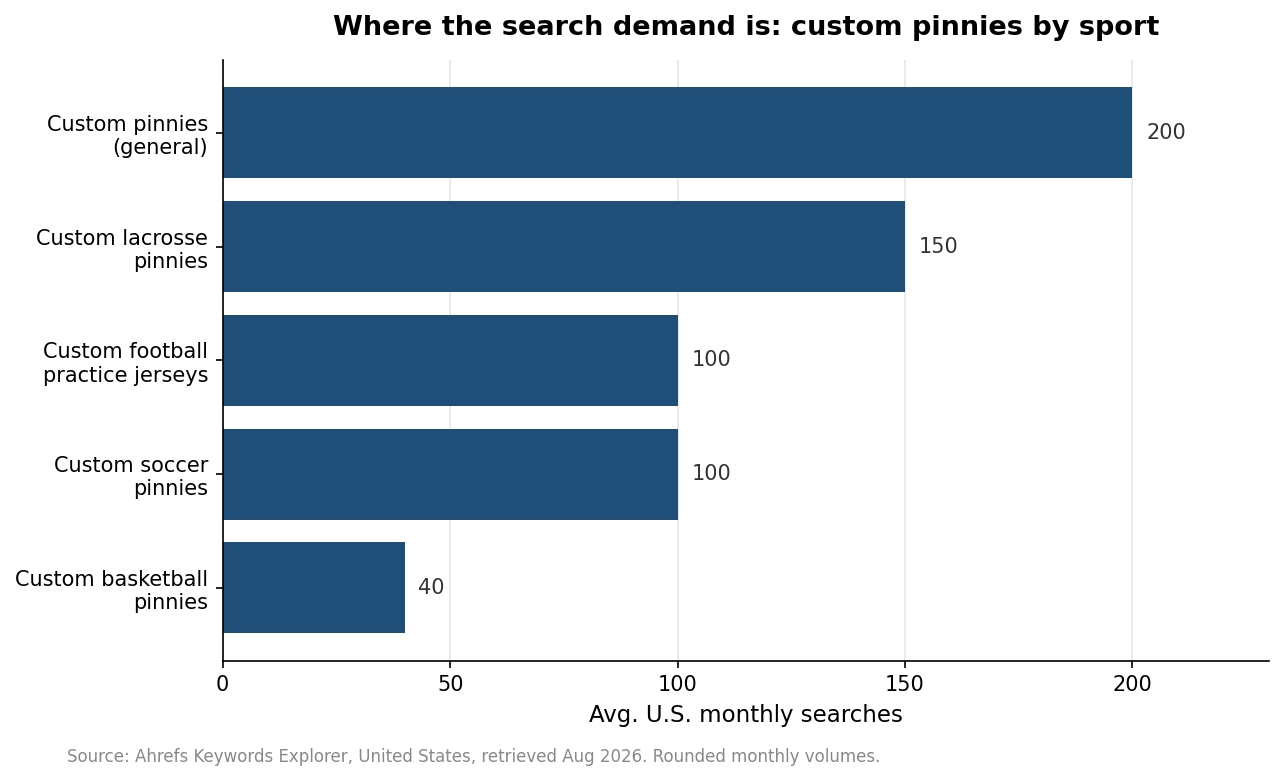
Lacrosse is the most demanding case, and it shows up in the search data above as the single largest pocket of custom-pinnie demand. Vests go on over shoulder pads and arm pads, so cut a size up from what a player would wear as a shirt, and favor a smoother micro mesh that will not snag on pad straps. Numbers need to read over bulky equipment, so do not shrink them to save on print area.
Soccer pinnies are the classic lightweight case. Players wear them over a jersey with no pads, so a thin open mesh that breathes is ideal, and high-visibility color pairings such as neon over dark help coaches read spacing across a wide pitch. Youth soccer is also where sizing matters most, since a club ordering for a whole age group needs a real size range rather than one adult cut.
Basketball lives indoors and at speed, so lightweight breathable mesh and a racerback or wide-armhole cut win here; you want nothing that restricts a shooting motion. Football practice jerseys sit closer to lacrosse: they go over pads, so up-size and choose durable mesh, and expect to number them large. Field hockey, volleyball, and general PE classes all fall between these poles, and the same three levers, mesh weight, cut, and number size, cover them.
Screen print or sublimation for the decoration
The decoration method decides how your colors and numbers get onto the mesh, and it is a genuine trade-off rather than a quality tier. Screen printing lays ink on the surface of the fabric. It is economical for simple designs with one or two colors and clean shapes, which describes a lot of numbered scrimmage vests, and it is often the faster route for a plain team set. Its limits are color count and the slightly heavier hand where ink sits on top of the mesh.
Sublimation dyes the color into the fiber itself, so there is no ink layer to feel, no practical limit on the number of colors, and gradients or photographic logos reproduce cleanly. That makes it the better fit for multicolor crests, complex patterns, or a program that wants a premium look. The catch is that sublimation works properly only on light polyester, so it shapes your color choices. For a straightforward numbered pinnie in one or two colors, screen printing is usually the sensible pick; for anything visually ambitious, sublimation earns the upgrade.
Sizes, minimums, lead time, and cost
Ask for a real size chart before you commit, because youth sizing varies between manufacturers and a vest that fits over pads is not the same as a fitted shirt. As a rough reference point, published soccer pinnies run about 19 to 20 inches wide in youth and 23 to 24 inches wide in adult, but always confirm against the specific product. Minimum orders for custom work commonly start around 10 pieces, though some suppliers will do smaller runs, and turnaround for a fully custom set is often in the neighborhood of a four-week production window after art approval, with the initial design proofs coming back in a day or two.
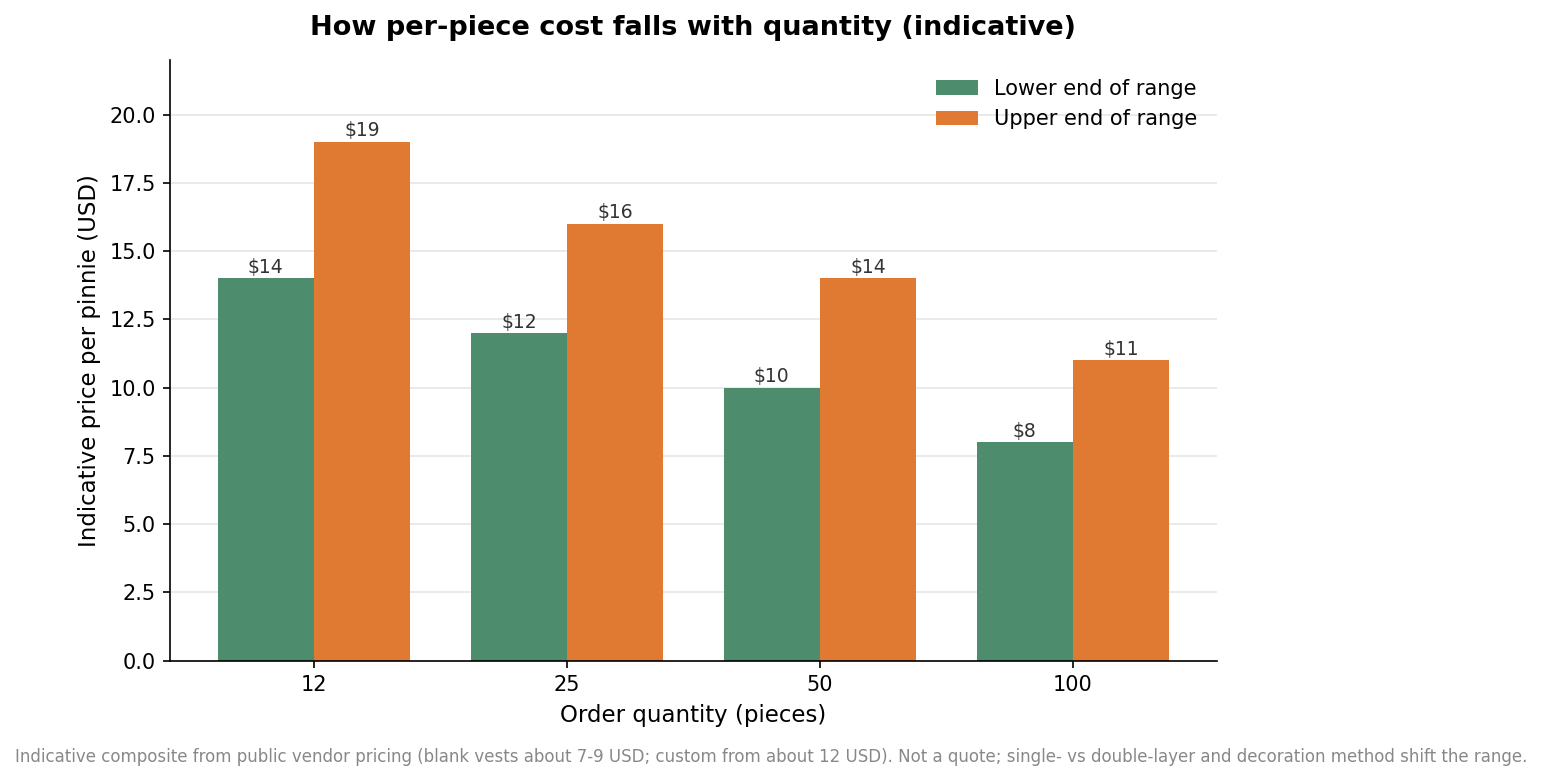
On price, the pattern is the usual one for decorated apparel: the per-piece cost drops as the quantity climbs, because setup is spread across more units. Blank stock vests sell for roughly seven to nine dollars each, while decorated custom pinnies commonly start around twelve dollars and climb with layer count and print complexity. The chart below sketches how the per-piece figure typically falls from a small order to a full club run; treat it as an indicative shape, not a quote, since reversible construction and decoration method move the numbers. The practical takeaway is to order for the whole roster plus a few spares in one run rather than topping up later at a higher unit price.
Put those decisions together and the specification writes itself: pick a mesh weight and hole size for your sport, decide reversible or single-layer, set your number heights, choose screen print or sublimation to match your design, and order the full quantity at once. Get those five right and the pinnies will do their quiet job at every practice for seasons, which is all anyone asks of them.