Pinnies never see a referee, so no rulebook forces a number size on them, and that is exactly why buyers get it wrong. A set turns up with numbers that look fine flat on a table and then disappear the moment players spread out across a full pitch. There are only two good reasons to put numbers on training bibs in the first place: to identify players quickly during drills and small-sided games, and to mirror the game kit so what a squad practices in feels like what they compete in. Both reasons point to the same shortcut. Borrow the number standards from the sport’s actual game jerseys and use them as your baseline.
Back numbers are the standard that matters most
The number on the back does the real work, because that is the view a coach has of a player running away from them. Across common team-uniform standards, adult back numbers cluster tightly: 8 inches for basketball, soccer, and baseball, and 10 inches for football and hockey. Youth sets typically drop to 6 inches on the back for basketball and baseball, while soccer and the two 10-inch sports often keep the back number full size so it still reads across the same fields and rinks. Pinnies are not bound by any of this, but matching it is the safest call you can make, because these sizes were chosen to be read at playing distance.
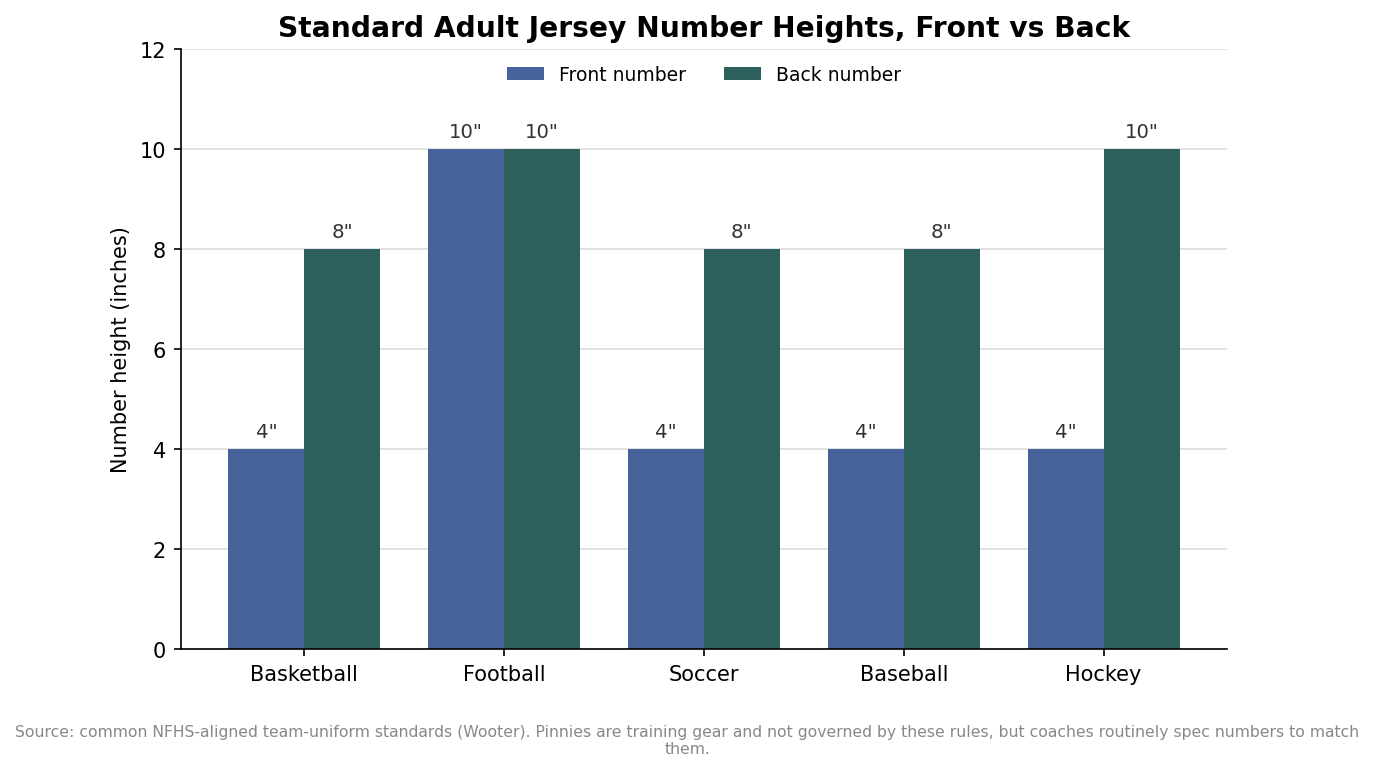
Two footnotes are worth knowing if your program runs older or more competitive players. Professional and international kits go bigger than the school standard: the NBA uses front numbers of at least 6 inches and backs of at least 8, and FIFA soccer back numbers run roughly 25 to 35 centimeters, which is about 10 to 14 inches. If your pinnies are meant to feel like the senior game, size up toward those figures rather than down.
Front numbers, shoulders, and where pinnies differ
Front numbers are smaller almost everywhere, and on pinnies they are often optional. The standard front number is 4 inches for basketball, soccer, baseball, and hockey, with football the outlier at a full 10 inches front and back. Youth front numbers usually shrink by an inch or two. Many training pinnies skip the front number entirely or use a small chest number or initial, because the front of a mesh bib is prime space for a club crest or sponsor and a large front number competes with it. The one place pinnies genuinely diverge from game kit is reversibles: if the bib flips between two colors, any number has to be legible against both, which usually means an outlined number or a number placed on a solid printed panel rather than raw mesh.
How big is big enough? Run the legibility math
There is a simple rule from the sign industry that translates directly to numbers: about one inch of character height buys you ten feet of easy readability. An 8-inch back number is comfortable to about 80 feet, and a 10-inch number to about 100. That sounds generous until you measure a field. The length of a basketball court is roughly 94 feet, so an 8-inch number is already near its limit end to end, which is why the bigger sports and the pros push to 10 inches and beyond. On a full soccer pitch, where a coach on the halfway line can be 150 feet or more from play, even a 10-inch number is working hard, and contrast becomes as important as size.
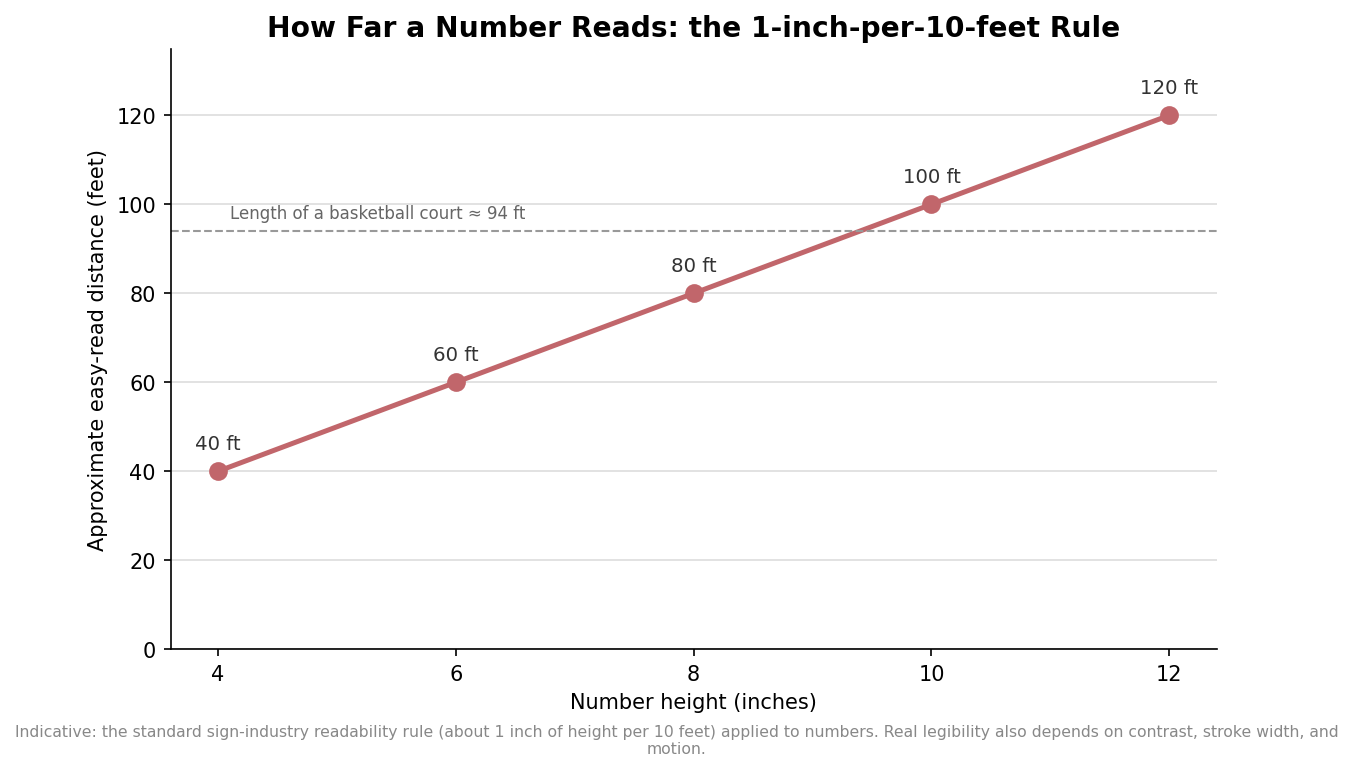
The practical read on that curve is this. For adult sessions on full-size surfaces, 8 to 10 inches on the back is the honest floor, not a luxury. For youth training on smaller pitches and shorter sight lines, 6 inches usually reads fine and keeps the number in proportion to a small bib. Treat the rule as indicative rather than exact, because a stationary sign in daylight is an easier target than a number bending across a moving player’s back, but it gives you a defensible starting point instead of a guess.
Contrast and stroke width do half the work
A big number in the wrong color still vanishes, so size is only half the specification. A widely cited target is a contrast ratio of about 4.5 to 1 between the number and the fabric behind it, which is why white or black numbers on a saturated bib outperform tone-on-tone every time. Stroke width matters just as much as height: NFHS football, for instance, calls for a number stroke of at least an inch and a half, and a tall number drawn in a thin, stylish font reads far worse than a shorter number with a bold stroke. On open mesh the problem compounds, because a thin outline breaks up against the holes in the weave. The fix is the same one that keeps print from cracking off pinnies in general, which is to carry numbers on a solid printed panel rather than bare mesh so the character has an unbroken field to sit on.
Speccing numbers for a squad set
When you order, decide first whether you want a roster set with specific player numbers or a sequential set, commonly 1 through 20, that any player can grab. Sequential sets are the workhorse for open training and cost less to manage because there are no reprints when the roster changes. For reversibles, confirm whether you need numbers on both sides and both colors, since that effectively doubles the decoration. Center the number high on the upper back where it clears a player’s shorts and stays visible when they bend, and keep the placement consistent across sizes rather than pinning it to a fixed measurement, so a 10-inch number does not swallow a youth extra-small while looking lost on an adult large. Hand your supplier six things and the quote comes back clean: the sport, the back and front number heights you want, the font or number style, the color plus any outline for contrast, whether the number sits on mesh or a solid panel, and single or double sided. Get those right and a squad set reads the same on the first day of preseason as it does under the lights.